Rolling Stones

In December 1997, while most of the world was still figuring out how to use email, Mick Jagger did something unexpected: he became a sports streaming pioneer.
Frustrated by the lack of live cricket broadcasts while touring with the Rolling Stones, Jagger formed a company called Jagged Internetworks and partnered with Cricinfo to stream the Akai-Singer Champions Trophy online, a tournament featuring England, Pakistan, India, and the West Indies that no traditional broadcaster planned to air. Jagger provided a glimpse into the future of sports consumption, delivered over dial-up internet connections to a handful of curious early adopters.
Nearly three decades later, Jagger’s vision has become the dominant reality. And in early 2026, (almost 29 years to the day after his cricket streaming experiment) YouTube TV will launch its dedicated Sports Plan, a genre-specific package that fulfils exactly what Jagger was attempting: giving sports fans direct access to the content they want without paying for everything else. The circle completes itself: what began as a rock star’s workaround has become the industry standard.
The Numbers: A Market in Transformation
The financial trajectory of sports streaming tells a story of explosive growth that has fundamentally reshaped the entertainment landscape. The global sports streaming platform market was valued at $33.93 billion in 2024 and is projected to reach $75.17 billion by 2030, representing a compound annual growth rate of 12.6%. To put that $41 billion increase in perspective: That is equivalent to building 10 new state-of-the-art NFL stadiums every single year for six years.
In the United States alone, an estimated 118 million viewers stream sports by 2025, a 71% increase compared to 2021. Meanwhile, traditional cable TV viewership dropped from 90.7 million in 2023 to 85.7 million in 2024. For the first time in history, digital viewership is poised to decisively eclipse traditional broadcast, an inflection point that seemed unimaginable when Jagger made his first digital cricket broadcast.
As of January 2024, Amazon Prime Video leads as the most popular streaming app for sports content, with 41% of respondents using it, followed by ESPN+ and Peacock. These platforms experienced remarkable growth in Q4 2024 when sports content drove a 2% quarter-over-quarter increase in subscription video-on-demand services, the first growth after a year of category contraction.
North America dominates this market, accounting for more than 35% of global revenue share in 2024, driven by the region’s leadership in streaming technology, high-speed internet infrastructure, and the growing adoption of 5G networks that make seamless streaming possible even on mobile devices.
From Experiment to Standard
We have been talking a lot about sports streaming of late and following proposed Netflix acquisition of Warner, the announcement of YouTube TV’s Sports Plan in December 2025 represents more than just another streaming option for the consumer. The YouTube TV Sports Plan will include all major broadcasters (ABC, CBS, Fox, NBC) along with sports networks like FS1, NBC Sports Network, all ESPN networks plus ESPN Unlimited, with add-ons for NFL Sunday Ticket and RedZone.
What Jagger cobbled together with Jagged Internetworks and Cricinfo (a niche solution for cricket fans frustrated by broadcast blackouts) has evolved into over 10 genre-specific packages designed to give viewers greater control. The streaming giant promises pricing below its current $82.99 monthly base rate, making dedicated sports viewing more accessible than ever.
Christian Oestlien, YouTube’s VP of subscriptions, framed the new offerings as fulfilling what YouTube TV was meant to be from the beginning, addressing consumer frustrations about “having to rent your DVR [Digital Video Recorder] or set top box, the inability to have that mobile experience that you can take with you when you travel.” Frustrations Jagger was solving in 1997 when he couldn’t watch cricket on tour.
YouTube TV’s Sports Plan isn’t pioneering; it’s perfecting. Where Jagger needed to create infrastructure from scratch, YouTube TV leverages years of refinement, unlimited DVR, multiview, key plays, and fantasy view features. Where Jagger reached hundreds of early adopters, YouTube TV already serves millions with its base package and will offer sports-specific access to an exponentially larger audience.
The Platform Wars
The battle for sports streaming supremacy has become a high-stakes game of securing exclusive rights. Apple spent over $2.5 billion on a 10-year deal for exclusive Major League Soccer broadcasting rights. Amazon’s investment in Thursday Night Football has been equally transformative, with streaming viewership growing by over 2 million between the 2022 and 2023 seasons.
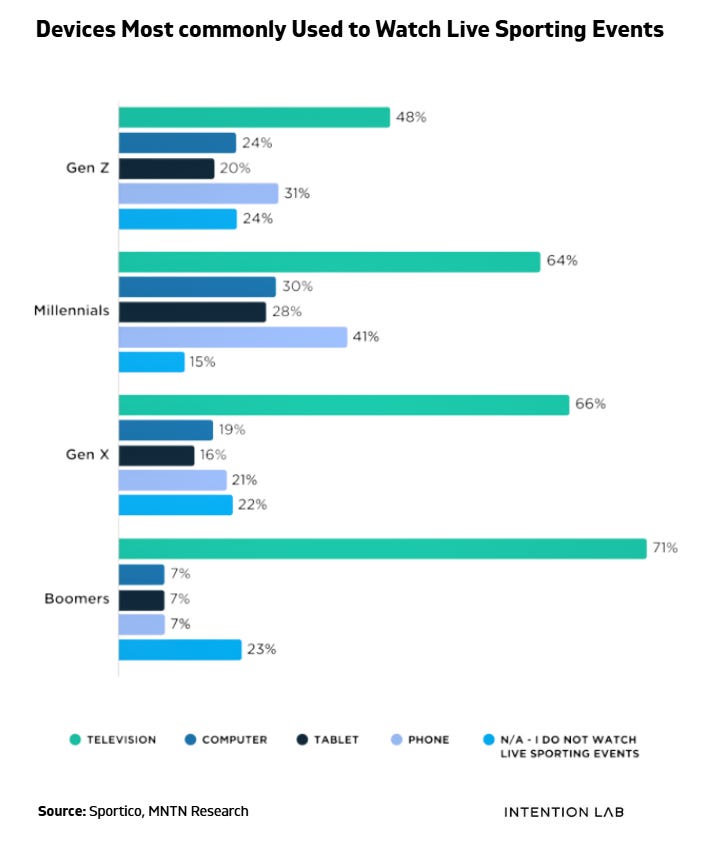
The current competitive landscape features major players (ESPN+, DAZN, FuboTV, Peacock, and Paramount+), each carving out their niche through strategic content acquisition. Football and soccer content dominates, representing over 40% of the sports streaming market by sport type in 2024, followed by basketball at 17%. The most popular viewing devices? Smartphones and tablets lead with approximately 50% of market share, fundamentally changing where and how we consume live sports.
Subscription rates reveal the urgency of this transformation: 38% of U.S. internet households now subscribe to at least one sports-specific streaming service, a dramatic increase from just 4% in 2019. This tenfold increase in six years represents one of the fastest adoption rates of any digital service category in modern history.
The Generational Divide
Perhaps the most revealing aspect of the streaming revolution is the generational gap in sports consumption. Only 53% of Gen Z identify as sports fans, compared with 69% of Millennials and 63% of adults generally. Among Gen Z sports fans, just 25% watch live competition weekly, compared to 48% of millennials.
Gen Zers who do watch live sports prefer digital platforms, with 32% utilising authorised streaming services compared to 28% who consume through broadcast or cable TV. Their preferred platforms are YouTube (49% using it several times per week), Instagram (44%), Snapchat (37%), and TikTok (31%)—all optimised for short-form, mobile-first content.
The data reveals a fundamental truth: approximately 74% of Gen Z gets most of its sports content from social media, more than any other generation. They’re not necessarily less interested in sports—they’re interested in experiencing sports differently. Only 52% of Gen Z sports fans say watching live sports is important to being a fan, compared to previous generations who viewed live viewing as essential.
The Interactive Revolution Ahead
If Jagger’s 1997 experiment represented sports streaming 1.0, we’re now entering an era that would have seemed like science fiction even a decade ago. The next iteration won’t just stream games, it will transform how we experience them.
Virtual and augmented reality stand at the forefront of this transformation. Industry leaders predict that within the next 3 to 5 years, streaming services will begin offering dedicated AR and VR content libraries, making immersive streaming a mainstream reality. While current adoption rates remain modest only 18% of younger fans report using AR or VR technologies at live games, platforms are investing heavily in these capabilities.
Sports streaming platforms are increasingly leveraging data analytics and artificial intelligence to deliver personalised content recommendations. Imagine choosing your camera angle in real-time, standing virtually on the side-lines during a crucial play, or seeing live statistics overlaid on players. Some platforms are already experimenting with features that let viewers switch between multiple camera angles, access alternative commentary tracks, and dive into detailed performance analytics.
AI-driven personalisation will fundamentally reshape the viewing experience. Streaming platforms are developing systems that learn your preferences, which teams you follow, which types of plays excite you, what level of statistical analysis you prefer, and automatically curate highlights, camera angles, and predictive insights tailored specifically to your interests.
Beyond Passive Viewing
The future of sports streaming recognises that younger viewers don’t want to simply watch, they want to participate. Integration with sports betting, daily fantasy leagues, and interactive prediction games transforms viewing from passive to active experience. Gen Z wants excitement within seconds, looking for what industry experts call “snack content” that distils hours-long games down to the most exciting moments ideal for sharing on social media.
The social dimension is evolving as well. Future platforms will enable virtual watch parties where fans from different continents can experience games together in shared digital spaces, complete with avatars, real-time reactions, and interactive polls. The boundaries between gaming, social media, and sports viewing are dissolving.
The Road Ahead
The sports streaming industry faces a critical inflection point. While the overall market continues to grow, subscriber loyalty remains tenuous, particularly around seasonal sports. Streaming services experience flat or declining subscriber bases post-football season, revealing that sports content drives acquisition but doesn’t guarantee retention.
The proliferation of platforms also creates subscription fatigue. U.S. households now subscribe to an average of 4.1 paid video streaming services, a number that has plateaued. With streaming now reaching 96% of U.S. households (125 million homes), the era of easy growth through market expansion is ending. Future success will depend on reducing churn, delivering superior personalised experiences, and creating compelling reasons for sustained engagement.
Despite these challenges, the trajectory remains clear. The global online live video streaming market for sports was valued at $26.93 billion in 2022 and is projected to reach $133.98 billion by 2030, growing at an even more aggressive CAGR of 22.66%.
The Inevitable Future
What Jagger understood in 1997, and what YouTube TV’s 2026 Sports Plan confirms is that technology doesn’t just change how we watch sports; it changes the fundamental economics of the industry. From a passive, scheduled broadcast to an interactive, personalised, on-demand experience that has unleashed an unprecedented bidding war for rights.
The numbers tell the story of this transformation. Streaming platforms are projected to spend $12.5 billion on sports rights in 2025 alone, one-fifth of the global annual TV spend. U.S. TV and streaming sports media rights payments will total $29.25 billion in 2025, expected to grow to over $37 billion by 2030. This represents a doubling from the estimated $14.64 billion spent in 2015.
The competitive intensity has never been fiercer. The new NBA deal that started in 2025 is valued at $77 billion over 11 years, split between Amazon, Disney, and Comcast, with streaming at the core. The NFL’s current rights cycle runs through 2033 at approximately $110 billion, with the league generating $23 billion in revenue in 2024 and targeting $25 billion by 2027.
The platform wars are being driven by cold subscriber mathematics. Peacock’s exclusive NFL playoff game in January 2024 cost $110 million but gained an estimated 2.8 million new subscribers from that single game. Netflix’s Mike Tyson fight pulled in 60 million households. The equation is simple: sports broadcasts equal new subscribers, and those subscribers generate monthly fees and advertising revenue.
Amazon’s share of global streaming sports spending will increase from 18% to 23% following its NBA rights acquisition, representing approximately $2.8 billion per year. YouTube TV remains in third place globally, driven mainly by its NFL Sunday Ticket deal worth a reported $2 billion per season. DAZN still leads the pack, accounting for one-third of all streaming sports spending.
The buying power disparity is staggering. Streaming-only companies from the tech world dwarf traditional broadcasters. Amazon had 6.8 times the buying capacity of Disney when the NBA deal was negotiated.
The advertising economics further accelerate this arms race. Brands spent over $389 billion on overall advertising in 2024, with $87.8 billion on all TV avenues. Of the 100 most-watched traditional TV broadcasts in 2024, 80 were sports broadcasts, with NFL games representing 72 of those. A 30-second spot during the 2026 Super Bowl will cost advertisers $8 million.
The platforms that win this battle won’t just stream games, they’ll master the art of converting sports fans into loyal, high-value subscribers who generate predictable recurring revenue. They’ll reduce churn during off-seasons by bundling complementary content and creating year-round engagement. They’ll leverage sports as the Trojan horse that brings viewers to their platform, then monetise them through both subscriptions and premium advertising.
UFC is reportedly seeking $1 billion annually in its next deal, more than double the $500 million ESPN currently pays. When the NFL’s current deal expires, industry experts expect even higher valuations following the NBA’s $7.5 billion-per-year agreement.
When YouTube TV’s Sports Plan launches in early 2026, it will mark nearly three decades since Jagger’s pioneering cricket stream and will intensify an already fierce competition for viewer dollars and attention. The rock star who couldn’t watch his favourite sport while on tour found a solution that transformed an industry.
Like a rolling stone gathering speed down a steep hill, the momentum in sports streaming is undeniable, and it’s accelerating towards stakes that would have been unimaginable when Jagger first pressed “stream” in 1997.
Adventure on
Billymo
Every great performance starts with intention.
At Intention Lab, we fuse business intelligence with creative thinking, storytelling, and innovation to turn data into a competitive edge. We uncover patterns, decode complexity, and craft strategic narratives that inspire action. Whether optimising performance, shaping culture, or unlocking new opportunities, we help sports organisations—and beyond—move with clarity, creativity, and purpose.